Autumn between the four-thousanders
Four high-alpine days from Fiesch: above the Aletsch Glacier and from valley to valley, with good thermals and weak to moderate valley wind. Plus autumn light and the first fresh snow on the four-thousanders.
For you if this is true: You climb out in thermals and have already done some cross-country flying. You’ve been looking at the big mountains for a while.
The next step is high-alpine terrain at the most beautiful time of year: in September the thermals are good, the valley wind weaker and the cloud base high. That makes the terrain more accessible.
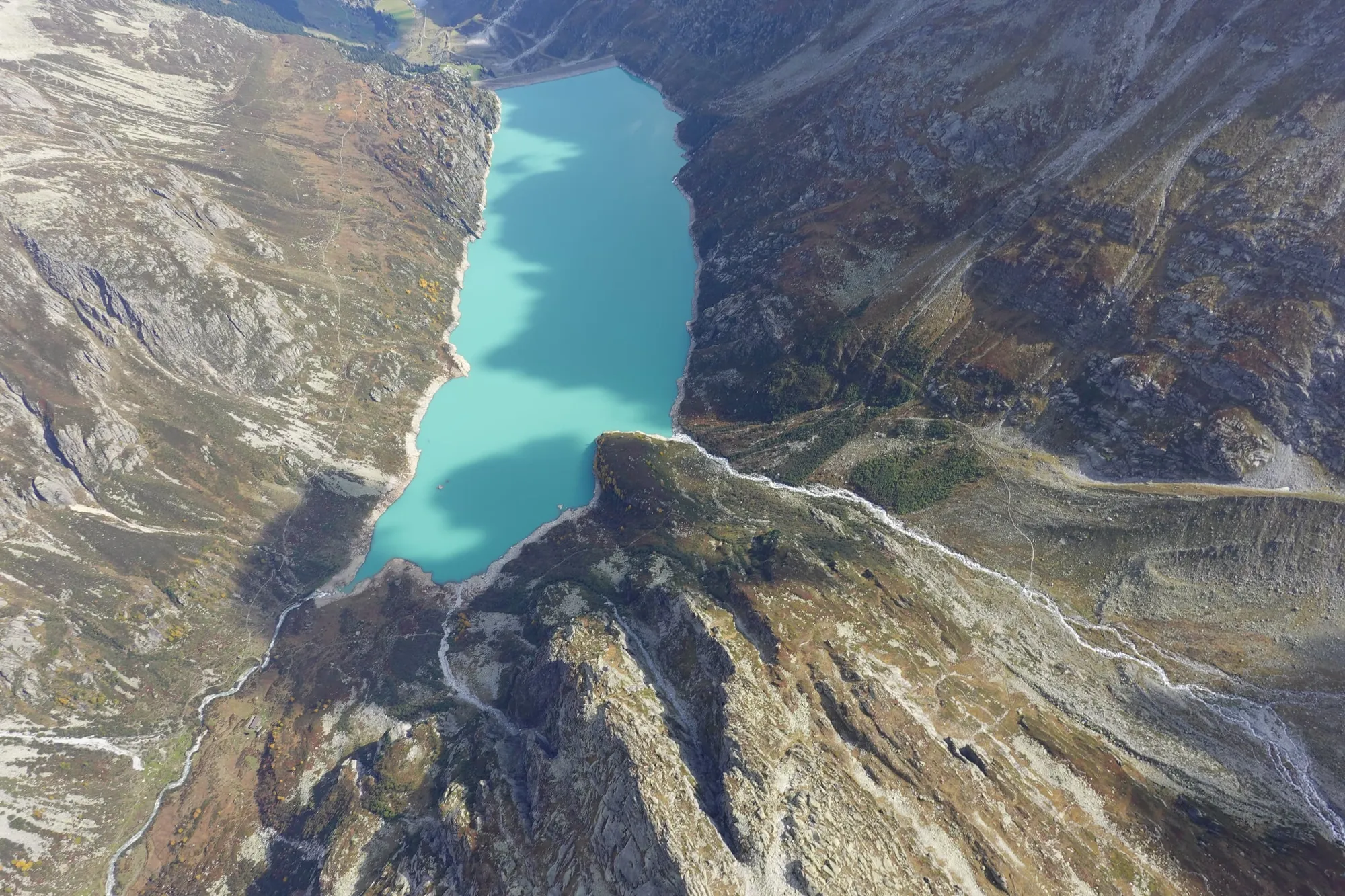
If you ask me when I most like to fly in Valais, I say September.
The sun is lower, the thermals stay good but get less strong than in high summer and that’s exactly why suddenly more is possible. Because as the thermals ease, the valley wind eases too. What is still an opponent in August is now moderate. And because both calm down together, the high-alpine terrain becomes more accessible and easier to experience.
Then there’s the light. The larches turn red and gold, the forests in the valley turn colourful, the first fresh snow lies on the four-thousanders and the air is so clear that you can see far beyond Valais. For me the most beautiful time of year in Valais.
Who this camp is for
For you, if you climb out in thermals, know your local hill and have been looking at the big mountains for a while. And if you want to fly them while the thermals are good and the valley wind is weak to moderate.
Where we fly
Our starting point is Fiesch, our base is at Flug-Taxi on the landing field: a lounge, a sun terrace and a room for the briefing. From there the launches of the whole region can be reached in thirty to sixty minutes and the morning decides which one, based on conditions, cloud base and valley wind.
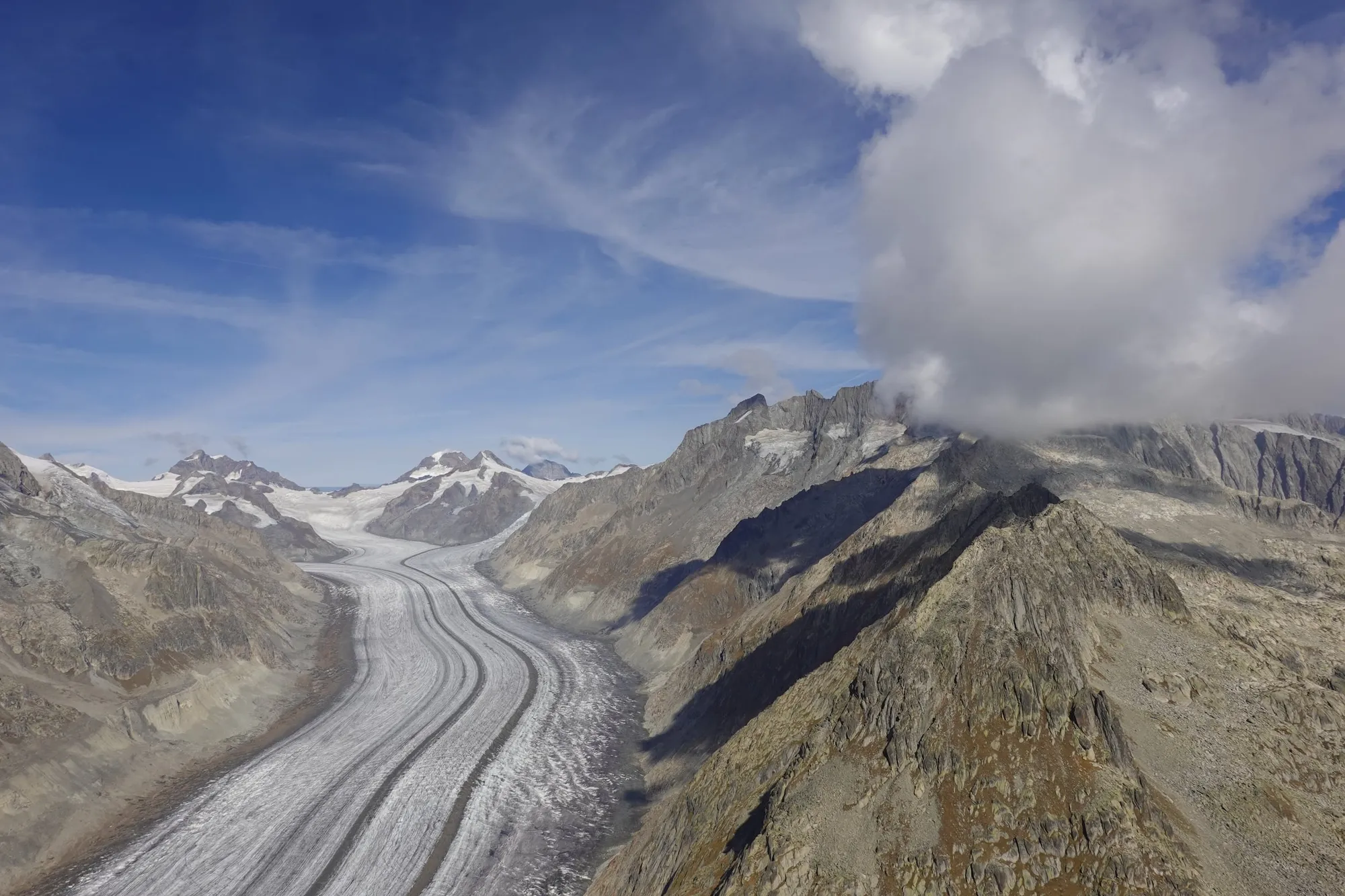
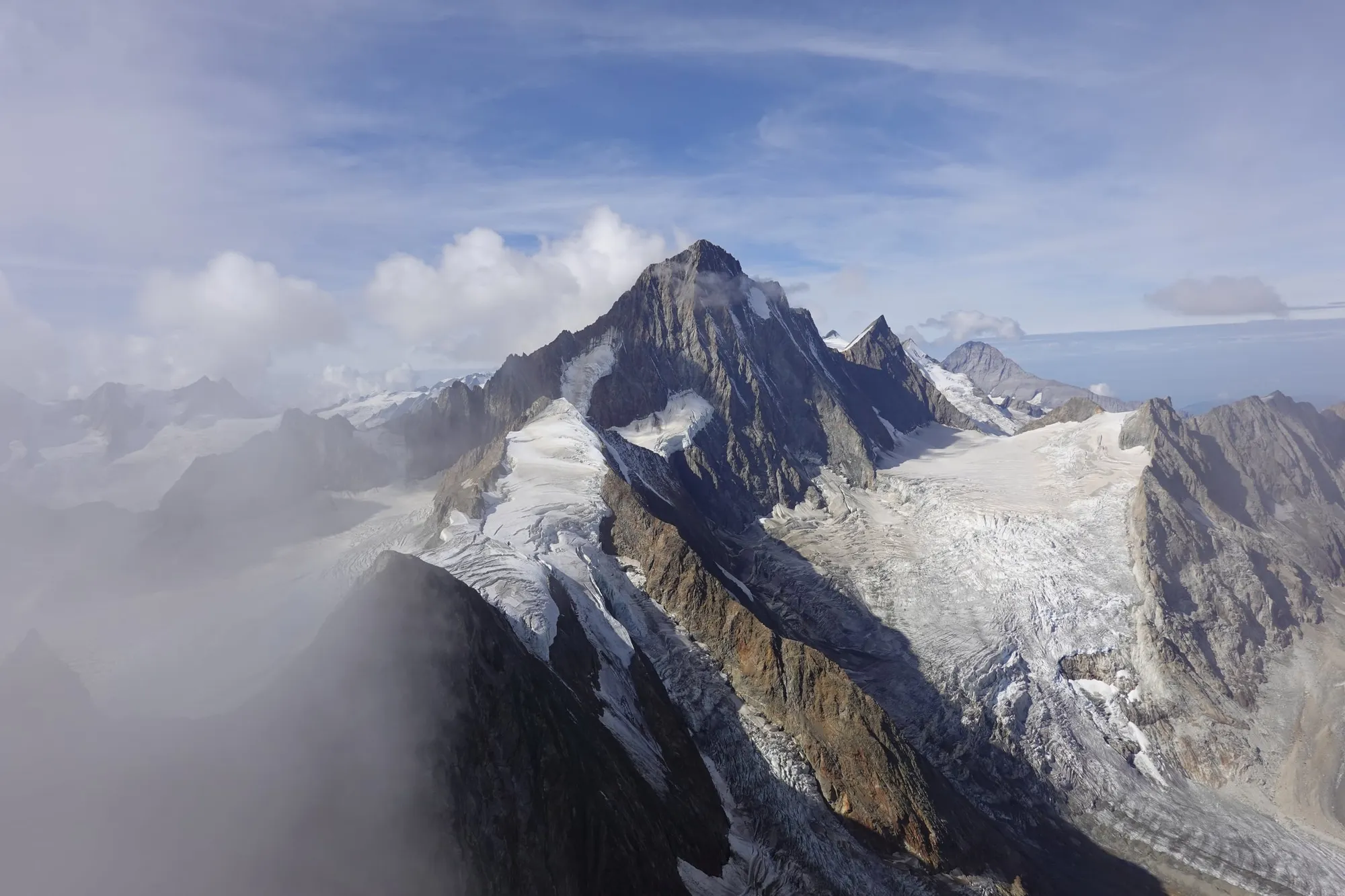
The day usually begins in the Aletsch region: Fiesch, out over the glacier, with the Finsteraarhorn in view.
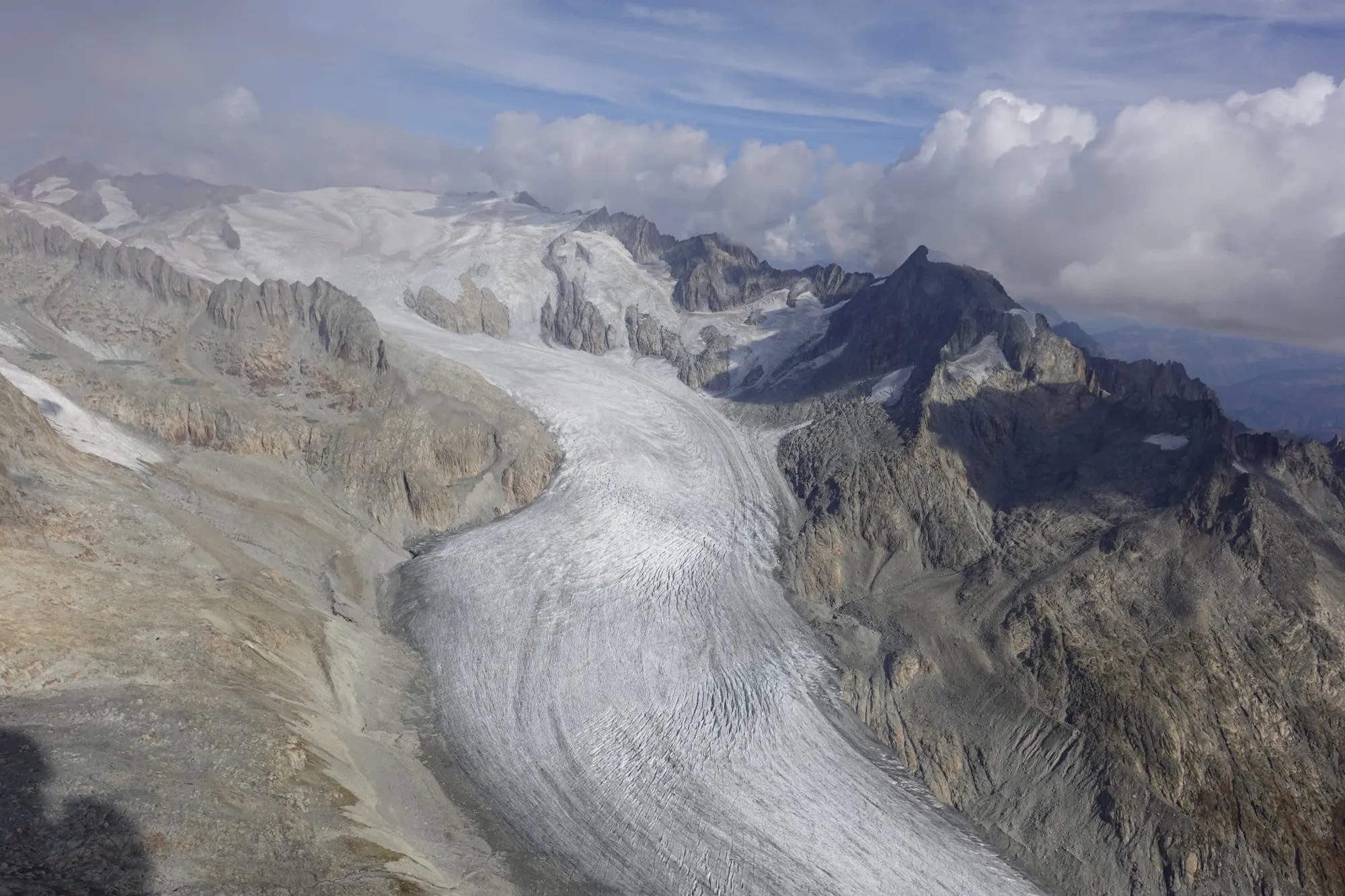
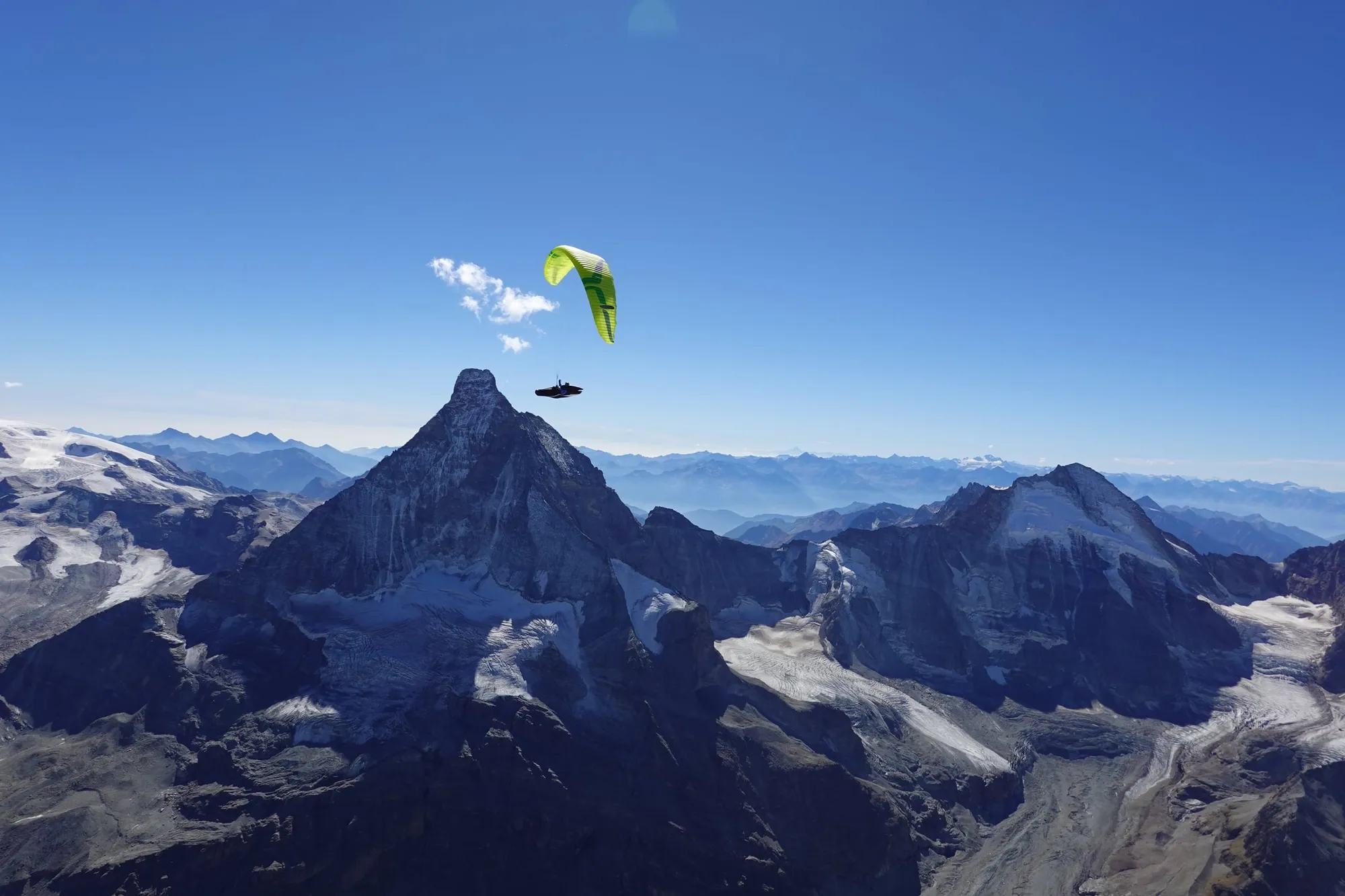
From there the day decides: on towards the Grimsel or across towards the Mattertal. We talk through the crossings before we fly them: how high you need to be, what the wind is doing in the next valley, what you do if it doesn’t work.
Where else we go
- Aletsch region with the Aletsch Glacier
- Mattertal towards Zermatt
- Saastal
- Grimsel region
If Valais doesn’t deliver
In autumn too, the Northern Alps or the Southern Alps are within reach, both with completely different weather. This way you can almost always still get a good day out of a mediocre situation.
What you learn
Reading the forecast. Which day has something to offer and where its potential and its hazards lie.
Planning the cross-country flight. Going through the line beforehand: where the key points are, where the hazards are and where the landing fields are.
Where thermals form and how they release. Trigger points in high-alpine terrain have a character of their own. I teach you about it.
Recognising hazards. How does the wind flow in the high mountains? Where does lee form and how far does it reach?
Dealing with steep terrain. Where you look for the thermals, when figure eights are worth it and when circling is the better technique.
Lines along high mountains. When the face is eight hundred metres high instead of two hundred, everything shifts: where you start, how high you need to be, when you go.
Key points. Recognising them, analysing them and solving them cleanly.
Where a spot commands your respect. We go through it together beforehand: what do you need to see to fly it? Where is your turnaround point? Getting further and staying safe on the way are the same question here, not two.
Whether this is the right camp for you
That matters to me, so every booking starts with a request. You tell me where you stand as a pilot and what you want to achieve in these four days, ideally with a track that is typical for you. I look at it and get back to you. If another camp or a coaching day fits better, I will say so. And if you would rather talk first: a short phone call is always possible.
Who it doesn’t suit
If you feel like flying long distances, Spring in Valais suits you better: the days are longer there and the routes further. And if you’re still searching for thermals and climbing out is still hard work, September is harder for you than spring: weak thermals need patience. A better start is then a coaching day for two.
Included
- Four days of guidance, in the air and on the ground
- A weather briefing and a site briefing every morning
- Guidance via push-to-talk app and radio: I give you the button for your phone to keep and lend you a headset and PMR radio
- Sites chosen with public transport in mind: after an outlanding you usually get back by train
- Debriefing and track analysis in the evening: you come away from every flight with a takeaway
- Photos and video from the air: I take pictures of you along the way and my 360° camera runs for the whole flight, for the debrief in the evening
- Exercises for afterwards: what went well for you and what could go even better, I turn into two or three exercises for your next flights
- A one-to-one conversation about your goal for these four days
Not included
- Travel to the camp: by train or by car, you organise it yourself. During the camp we get around by train and bus: where we land is still open in the morning.
- Accommodation: you book it yourself. That is on purpose: some sleep in a camper van, others in a hotel and booking ahead for everyone costs time and money. You get recommendations from me.
- Cable cars, train and bus tickets, food
- Insurance: third-party liability is mandatory, accident and rescue insurance strongly recommended
- The way back after an outlanding: we choose the areas so that the way back works by public transport
What you organise yourself
- Licensed paraglider pilot: SHV licence or at least IPPI 4
- Warm clothes, in September it gets cold quickly at altitude
- Your accommodation in or near Fiesch: you book it yourself and you get recommendations from me
A day at the camp
- 08:00
Weather briefing
We read the situation together and set Plan A, Plan B and Plan Z.
- 08:45
Site briefing
Launch and landing fields, airspace, the spots where you pay attention here.
- 11:00
Into the air
Cross-country with guidance over push-to-talk app and radio: sometimes I fly ahead, sometimes I fly with you.
- 16:00
Way back
Back to the starting point by public transport. Most of the day gets talked through on the way.
- 18:30
Debrief
The tracks side by side, mine included. The most important part of the day.
- 20:00
Evening
Dinner together for anyone who wants. Optional, four days in the mountains are tiring too.
Times are a guide. The weather moves them, not the plan.
Requirements
- A valid licence: SHV or IPPI 4
- You climb out in thermals and have already done some cross-country flying. You’ve been looking at the big mountains for a while.
- Airworthy, checked equipment: your wing is expressly allowed to be an A or B
- Vario with GPS
- Third-party liability insurance with at least one million francs of cover, plus accident and rescue insurance
- Mobile phone with a data plan: communication in the air runs over a push-to-talk app (Zello)
- Four days in a row free. At shorter notice there are the XC Days.
I don’t much mind what is hanging above you: the line and the right day decide, not the equipment.
I fly with you, I don’t fly for you. Launch, route, turning back and landing are your decisions: my assessment is a recommendation, not a clearance.
Dates and schedule
- Whether it goes ahead
- By 19 August 2027 at the latest, three weeks before. From 4 people the camp is on; if fewer come together, I call it off and you get back everything you have paid.
- If the weather doesn’t play along
- If the forecast gives roughly two and a half flying days, the camp goes ahead. If a single day doesn’t work at the starting point, we go to where it does: your accommodation stays where it is and if the route calls for it, I organise a driver. If the whole week looks clearly worse, I postpone the camp. On a day when nothing works at all, we work on the ground.
- Starting point
- Fiesch landing field
- Arrival
- 8 September 2027. Arriving the evening before isn’t compulsory, but it makes the first day much more relaxed.
- First flying day
- Thursday, 9 September 2027, meeting at 08:00
- End
- Sunday, 12 September 2027, around 18:00
Which camp suits me?
Every camp assumes that you fly thermals. Beyond that, the camps differ in what you bring along and what you want. Three sentences, one of them applies to you and behind it are the camps that are built for it.
- Learn cross-country flying
- You climb out in easy thermals. You have hardly flown cross-country yet, your flights have been shorter than about twenty kilometres.Afterwards you fly the same line again, this time without me on the radio.Season start in Ticino 15–18 Apr 2027The Goms 13–16 May 2027Thermal Camp in the Bernese Oberland 26–30 May 2027
- Fly further
- You fly thermals and have already flown cross-country: about twenty kilometres or more. Now you want to go further than before, longer lines, a new area or high alpine terrain.Afterwards you decide on the way yourself: when to go, where to cross, when to turn back.Spring in Valais 6–9 May 2027Between the four-thousanders 5–8 Aug 2027Between the four-thousanders, second week 12–15 Aug 2027The southern valleys of Valais 2–5 Sept 2027Autumn between the four-thousanders 9–12 Sept 2027 · this page
- The big lines
- You have already flown thirty to eighty kilometres and want to fly the big lines of an area together, from valley to valley.Afterwards you read the day yourself and lay your line by it, instead of following a ready-made one.XC Camp Flex – The best place 14–20 Jun 2027
Not that far yet? If you don’t climb out in every thermal yet, you don’t have to wait until it comes by itself: a coaching day for two shows where you stand and you take two or three exercises away for your next flights. Over the season add briefing and debriefing, so that every flight turns into a takeaway.
If you’re unsure which sentence is yours, write me one sentence on where you stand: flights, wing, longest flight. I tell you honestly which camp is the next one for you and if there isn’t one, I tell you that too. And if three or four of you are at the same point, I make days out of it just for you.